As Soloists, we often wonder. Where should we publish? What are the mediums that actually advance our craft and our business? What content and which mediums will move the needle for our business?
There are many to choose from. LinkedIn. YouTube. Substack. Instagram. Threads. X. Newsletters. Podcasts. Workshops. The list keeps growing every year, and every platform has its early adopters swearing this one is the one that works.
So we end up doing what most of us do. We spread ourselves thin. We post a little here, a little there, hope something sticks, and nothing substantial happens.
I have been wrestling with this for myself. Between client work, sales, and business development, I do not have the bandwidth to show up everywhere. I needed to pick. And for a long time, I kept picking wrong. Or to put it better, the way I was thinking about the question was wrong.
It started with a YouTube channel
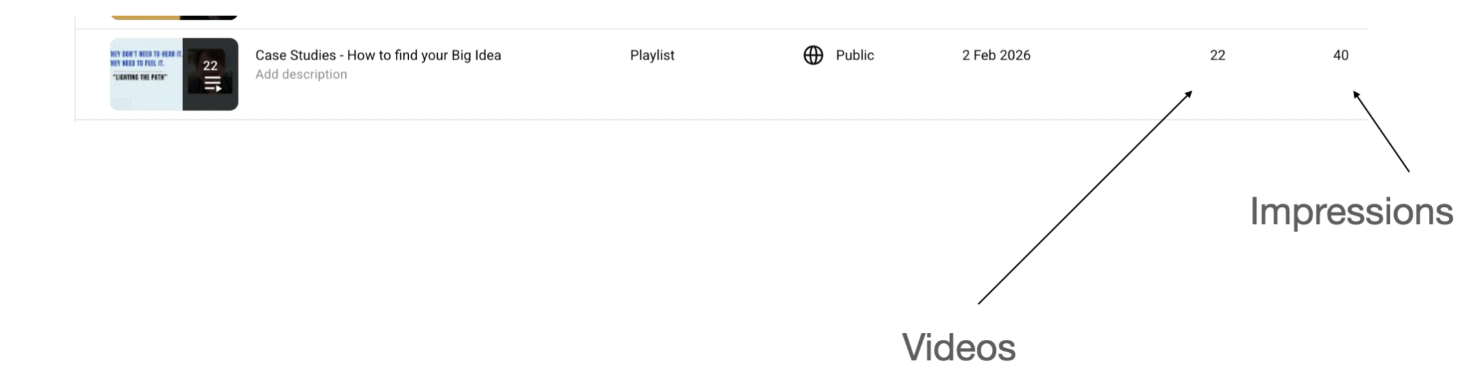 I started this channel in late 2025 because I felt the need for more Big Idea examples to talk about. This would help me have a better grasp of the topic. I began publishing case studies, breaking down the Big Ideas of brands I admired and trying to decode why they worked.
Consistency, though, was a struggle from day one.
I would publish for a week, stop for two, then push myself back into it. The whole process felt uninspiring and forced.
It felt like work.
Eventually, I stopped.
For a long time, I blamed myself. I just was not disciplined enough. But the truth was different. I was not lazy.
I was in the wrong place.
An email to Liam Curley
While I was sitting with this confusion, I decided to write to Liam Curley. He is a Soloist I admire and respect. He had been building a strong YouTube channel and was now slowly transitioning into a narrative-style podcast.
This is what I wrote to him.
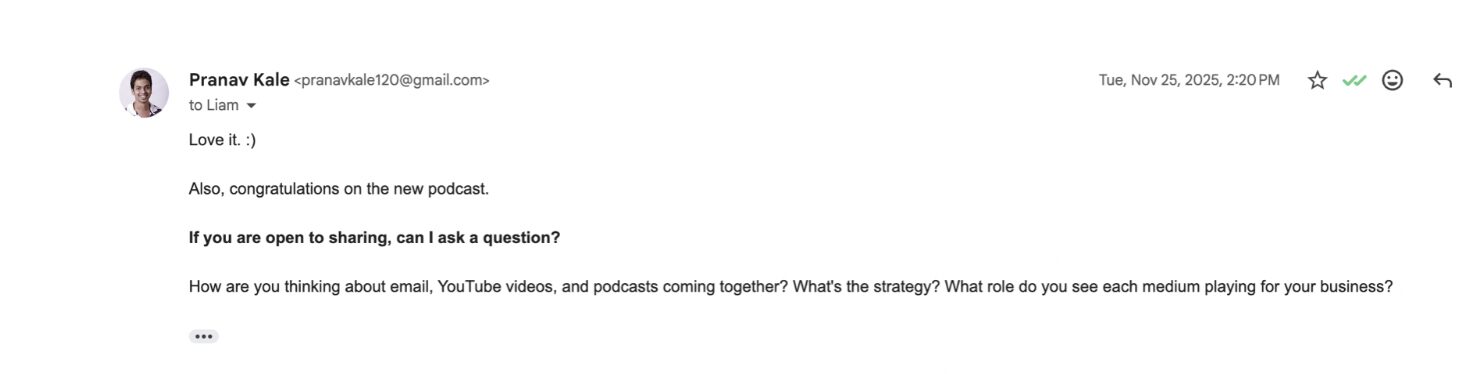 I was curious to know how he was thinking about email, YouTube, and podcasts coming together. What was the strategy? What role did he see each medium playing for his business?
A client was doing something similar
Around the same time, I was working with a client who helps tech founders raise money. He does this by helping them tell the story of their startup. He has been at it for ten years and is very good at what he does.
His clients adore him. But when it came to new prospects and audiences, he was struggling to get traction for his ideas.
When we started working together, we could have taken the obvious route. Publish on LinkedIn three times a week, build an email list, send case studies, and wait for clients to roll in. He had tried all of that already.
It had not worked.
So we did something simpler. We started publishing longer articles on his website, 700 to 1000 words each. The writing was thoughtful, nuanced, and something he genuinely enjoyed. As we published, we also started having conversations with peers, ex-clients, and others in his circle.
Nothing happened for a while. Until it did.
One of his friends, someone he plays basketball with, casually introduced him to a well-known VC. The VC is in his late 60s, influential, well-connected, and has spent his entire life in startups.
The VC did his homework
Before the meeting, the VC did what anyone would do. He looked up my client. Went to his LinkedIn. Found one of those thoughtful articles and read it.
The article touched a nerve.
The one-hour coffee meeting they had planned?
It turned into four hours.
My client’s writing had resonated deeply. It made the VC feel seen and heard. He had been quietly carrying a frustration that nobody around him quite understood, and the article had put words to it.
You might expect this to be the part where clients start pouring in.
They didn’t.
Nothing happened for weeks. But my client kept the relationship alive. He sent the VC a 60-minute lecture he had recorded for a different group of founders, a dense and careful piece of thinking about how investors actually make decisions, and asked for feedback. The VC gave him thorough feedback in return.
Two months later, the VC introduced him to three prospects. Two became paying clients. The third is on the verge of becoming one.
I sat with this story for a long time. Something was happening here, and I could not quite put my finger on it.
My own ignored evidence
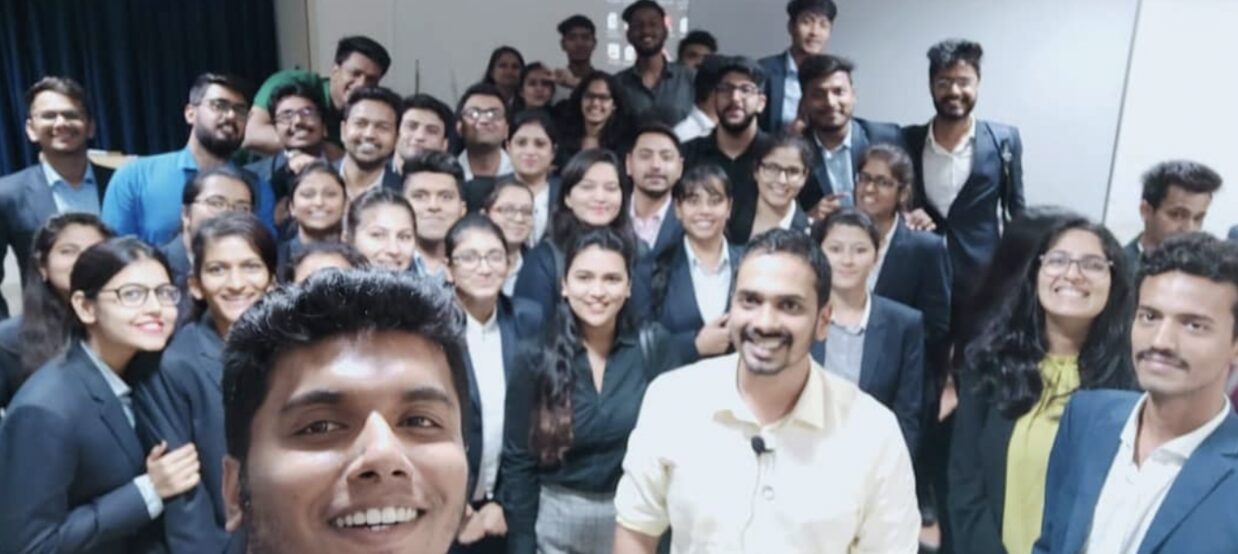 This is me, years ago, teaching marketing to MBA second-year students as a visiting faculty while I was working at an agency. And honestly? I liked it more than my day job.
There was something about it. The eyes going wide when something clicked. The energy in the room. Building toward an insight together.
I lost touch with it. I stopped teaching for a few years for one reason or another, but the nostalgia stayed. I would mention it to my wife every few months, saying that I wanted to get back to teaching, and then do nothing about it.
Until last month.
I ran my first workshop in years. The feedback, honestly, surprised me.
“I run my content through your framework now.”
“I’ve trained my Claude on the workshop content.”
“You helped me unlock my origin story.”
I had a small facepalm moment.
Why did I wait so long? If I love teaching, why didn’t I put a workshop together sooner?
The fear I had been hiding
If I am honest, only one thing had been stopping me.
I was worried that no one would show up. That I would send out a calendar invite, schedule the Zoom, prepare the slides, and find myself staring at a blank screen.
This fear is a silent killer of our best work. There are places we know we want to show up. Things we know we want to make. But the only thing keeping us from doing them is the quiet worry that no one will pay attention.
So we retreat. To LinkedIn. To Instagram. To YouTube. To email. We get pulled towards them because they make a quiet promise.
The promise is this – you do not have to figure out distribution. Just post. We will handle it. The algorithm will show your stuff to people.
 That promise is a huge relief. Because most of us hate the icky work of promoting ourselves.
We love the work.
We do not love asking people to look at the work.
But the platforms don’t always keep their end of the bargain. The algorithm changes its mind. Our posts get buried. We publish what we believe is our best thinking, and nothing really happens. The platform was supposed to take care of distribution. It doesn’t.
We notice this, of course. But we shrug it off and keep going, because the alternative feels even harder.
Now compare all of this with committing to a podcast. Or a workshop. Or a book. Or an essay series with a small mailing list.
There is no feed. No algorithm. No post and pray. If you commit to those mediums, you are personally responsible for getting people there. You have to DM. Email. Build relationships. Send the thing one human at a time. Maybe even ask for favours.
The work is heavy. So we retreat.
We pick the platform that promises to handle distribution for us, even when it is not where our best work lives. Then we tell ourselves it is a strategic choice. “That’s where my audience is. That’s where the algorithm favours my niche.”
It sounds rational.
And maybe it is. But it’s not effective.
How I dealt with the fear
It was not by retreating to LinkedIn. And it was not by pretending the fear did not exist.
I just asked myself a different question.
Can I get three people to show up for the workshop?
That’s it.
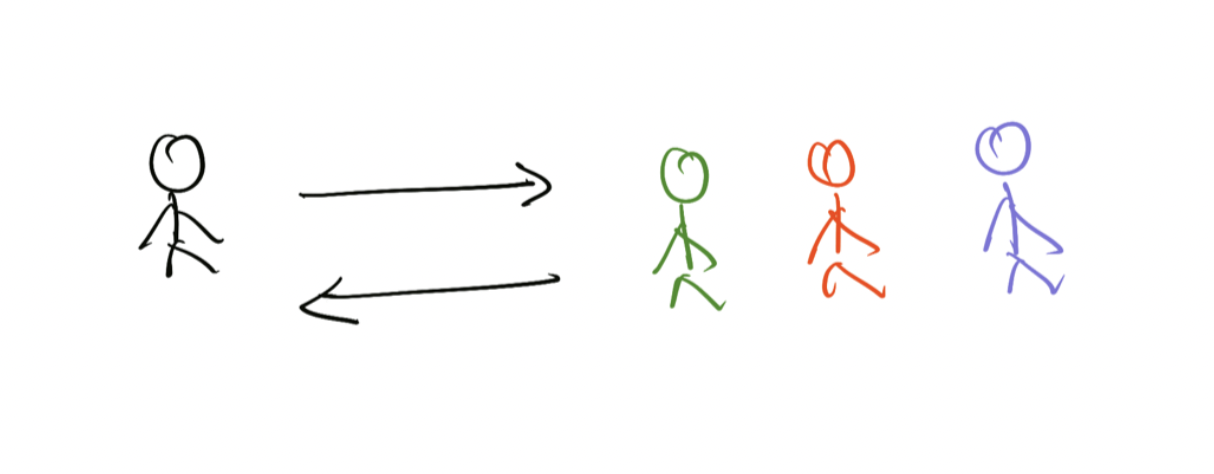 If my target is three, the attention problem becomes solvable. I can DM a few friends. I can email a couple of clients I am working with.
And the moment three is handled, the rest of my attention is freed. I can put all my efforts into building a good workshop.
To be clear, this has not revolutionized my business. It is far too early for that. But “business revolution” is not the point. The point is the commitment. If I do not commit to a medium, to a practice, it will definitely not change anything. Commitment does not guarantee success, but the absence of it guarantees failure.
What Liam wrote back
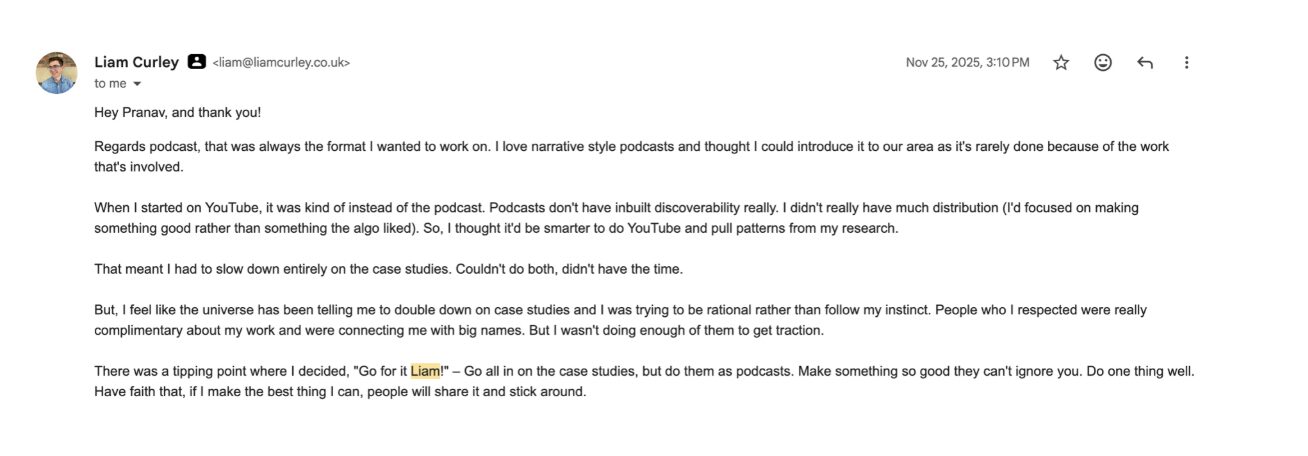 Read that last paragraph twice.
There was a tipping point where I decided: go for it, Liam. Go all in on the case studies, but do them as podcasts. Make something so good they can’t ignore you. Do one thing well. Have faith that if I make the best thing I can, people will share it and stick around.
Liam was not optimizing for the medium that would do his distribution for him. He was committing to the medium where he could make the best thing he was capable of making.
The shift
After Liam’s reply, the thing I had been circling around finally clicked. Check the image below. The things on the left… yeah, they need to be converted to their counter-parts on the right.
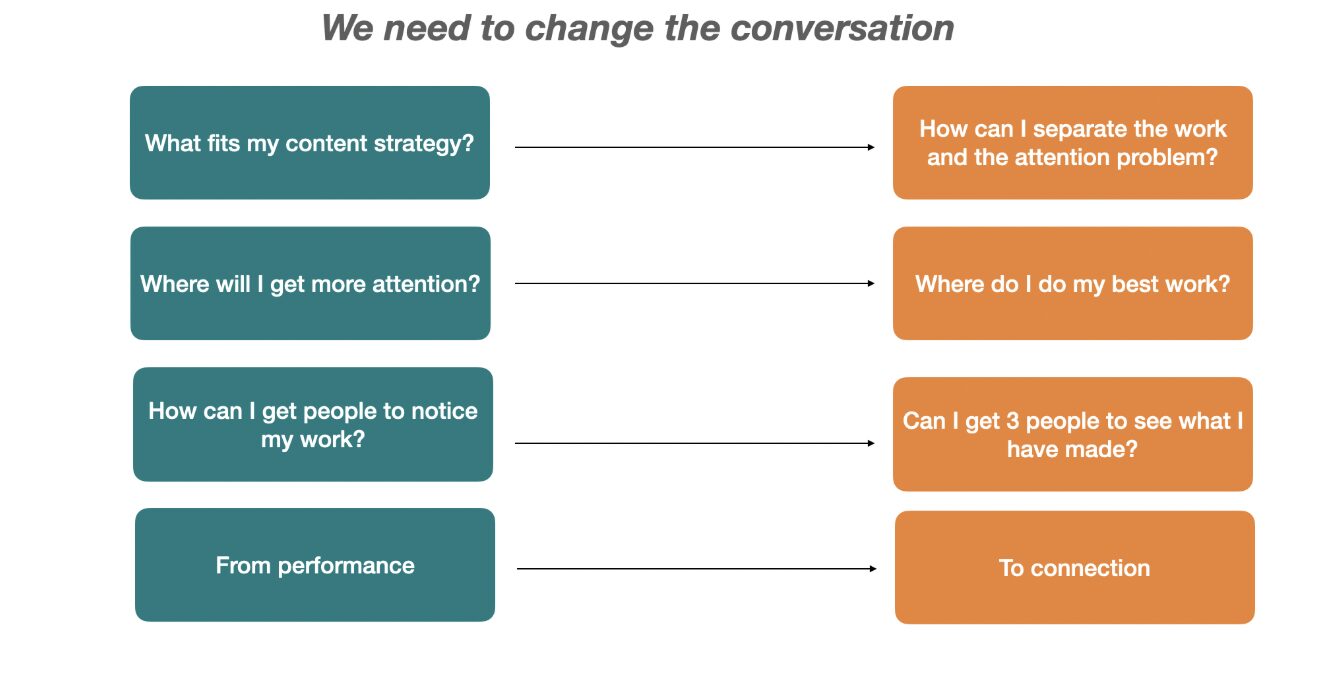 It stops being about what will perform. It starts becoming about what will connect with the audience.
The pattern
This is what Liam was doing with his podcast.
This is what my client was doing with his articles and his 60-minute lecture.
This is what I am trying to do with these workshops.
None of us was trying to solve the work problem and the attention problem in the same move. We were committing to the medium where we could do our best work, and then taking efforts to get it in front of people.
But attention is still a real problem
This is not to suggest “build it and they will come.” Doing your best work does not automatically attract an audience.
We do need to do our best work AND worry about getting attention for it. We just don’t need to compromise the quality of our work to make the attention problem easier. We don’t need to retreat to platforms we don’t like, or where we can’t do our best work, just because it is the standard advice.
This is about decoupling the two problems. Medium and attention.
Solve them separately, not at the same time. Do your best work. Then think about getting three people to see that work.
A workflow
Here is the simplest version of what I have been describing.
Step 1:
Choose a medium as a hypothesis. You are not committing for life. You are running an experiment.
Step 2:
Get three people to engage with what you make. Do this three times. DMs, emails, calling in a favour from a peer. Whatever it takes.
Step 3:
Did it work? If no, go back to your hypothesis. (Don’t worry. You know where your potential lives. You are not choosing from a hat.)
Step 4:
If yes, master the medium. Go all in. Learn the craft until you can do it in your sleep.
Step 5:
Then, and only then, get good at promotion.
The order matters. We tend to do this in reverse, optimizing for promotion before the work is even good. That is why most of it does not land.
How to find your medium
How do we identify the platform where we do our best work?
Success leaves a trail. The evidence is in your own life. You just have to look.
Three questions to sit with.
- Think of a moment when you created a genuine connection with someone through your work. A talk, an essay, a workshop, a one-on-one conversation, a sketch. What was the format? Go back as far as you want. School, college, kids, side projects. Nothing is off limits.
- What is the kind of work that leaves you with more energy than you started with? Not just the start, but the end. What was it, and what format was it in?
- When has someone come back to you weeks or months later, still quoting or referencing something you made? What was it? What was the medium?
If your answers keep pointing in one direction, you have your hypothesis.
A menu of mediums
A rough map. Not exhaustive. There will be overlaps.
- Speaking publicly -> conferences, workshops, webinars
- Teaching -> workshops, courses, YouTube
- Facilitating -> cohorts, masterminds, in-person events
- One-on-one conversations -> connect calls, conversational podcasts
- Interviewing others -> interview podcasts
- Being interviewed -> guest spots, AMAs
- Storytelling -> narrative podcasts, YouTube
- Writing essays -> long-form blog, newsletter
- Visuals -> illustrated essays, diagrams, video
One strength can lead to several formats. One format can serve several strengths. Pick the combination that lights you up.
To close
There is no right platform. There is however, the right platform for you.
The shift this report is asking you to make is simple but uncomfortable. Stop optimizing for where the most eyeballs are. Start asking where you can do your best work. Then commit. Master the craft. Three people, three times.
Distribution comes later, and it is a real, separate problem that deserves its own real, separate solution.
But the best work comes first. That part is not negotiable.
For more stuff like this, subscribe here.