As Soloists, we want to be seen as credible. But the conventional ways of building credibility often make us anxious, forcing us to be who we are not. We try to sound more confident, sharpen our argument further, and project a certain charisma.
All of these are important. But are we missing something a lot more fundamental?
What if credibility isn’t something you perform, but something you produce?
It all starts with Instagram
I was wasting my time on Instagram when a video stopped my scrolling. A girl was talking about a 60 day challenge to improve her public speaking. Every day, she’d pick one specific skill, record a video demonstrating it, and publish it.
What pulled me in wasn’t the topic. There are endless public speaking resources out there, like the TED Speaking Course, the Dale Carnegie Course, and thousands more on Udemy and Coursera, all run by people far more popular than her. She had a few hundred followers.
So why did I feel a sense of trust developing for this particular account? Clearly, there was something else at play. Something a lot of us are missing in our marketing.
Credibility matters
Whenever someone comes across our content, they’re running a quiet BS filter: are you even legit? They may not say it this way. They may not even know they’re doing it. But getting past that filter is the real challenge.
So how do we usually try?
We populate our websites and socials with testimonials and logos. We work on storytelling, sounding smart, and making the argument stronger. Most importantly, we say it confidently, because confidence builds credibility. Subtly (or not so subtly), we strive to sound smarter, grander, bigger in every way. Because that’s what will make us trusted.
And if we don’t have any of that- no impressive logos, no bestselling book, no twenty years of experience- the pressure gets worse. We overcompensate and try even harder to sound like we belong.
These things aren’t wrong. If you’ve helped clients, put the testimonials up. If you have interesting logos, use them. But by themselves, they’re not enough. Something’s missing.
Copying my heroes
I’m a Seth Godin fanboy, so naturally I started publishing content that sounds like his: opinions, broad principles, general overviews.
These are a few LinkedIn posts I published recently.


These are legit insights. But they still wouldn’t get past the filter that asks, “Who are you, dude? Why should I trust you?”
I call this Podium Content: standing behind an imaginary podium, talking about principles and broader themes, teaching people. It’s not bad. It’s just incomplete.
So what’s the missing piece?
The best campaign against smoking
If you had to design the best campaign to get people to quit smoking, what would you do? Have medical professionals share their opinion? Publish stories of smokers who struggled to quit? Tour a factory where cigarettes are made?
According to the book Made to Stick (highly recommended), one of the most successful campaigns against smoking was led by a woman named Pam Laffin. Was she a scientist? Did she have special credentials? Nothing.
She started smoking at 10. Years later, she had to pay the price as her health severely deteriorated. When she appeared in the commercials, her credibility was inevitable. When she talked, people listened. Her experience couldn’t be faked.
A client didn’t hire me because of my storytelling
When I asked one of my Big Idea clients what made him trust me enough to hire me, it wasn’t my storytelling on LinkedIn or my thoughtful emails. It was that I’d been visibly wrestling with the topic in public, asking questions, sharing what I found along the way, sharing my confusion. I wasn’t trying to sound credible. I was just visibly doing the work. And that, apparently, was what made me credible.
The pattern
Pam Laffin. The Instagram girl. My own client. In every case, the person wasn’t projecting credibility. They were producing it, through evidence that was hard to fake.
So why does this work for Seth Godin?
So why does podium content work for him and not for me? Because I’m confusing my stage with his.
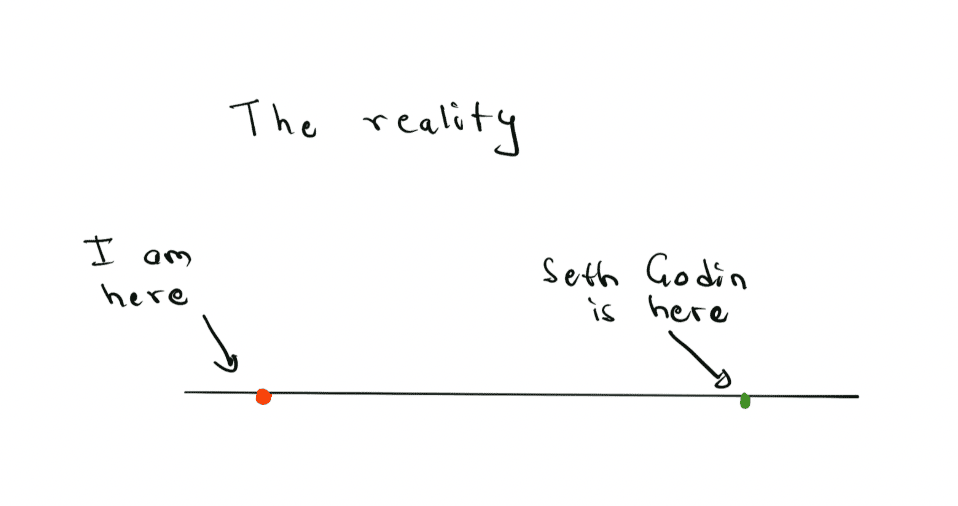
Seth Godin has launched companies, shipped projects, written bestsellers, and failed publicly over decades. He’s done an enormous amount of visible work, so his audience already trusts him. He’s earned the right to write in principles, because the evidence is already in the room.
Me copying his current style without having done any of that visible work? It doesn’t land. The trust isn’t there yet.

Credibility is not something you project
It’s not a costume you put on before stepping on stage. It’s something you produce through visible action.
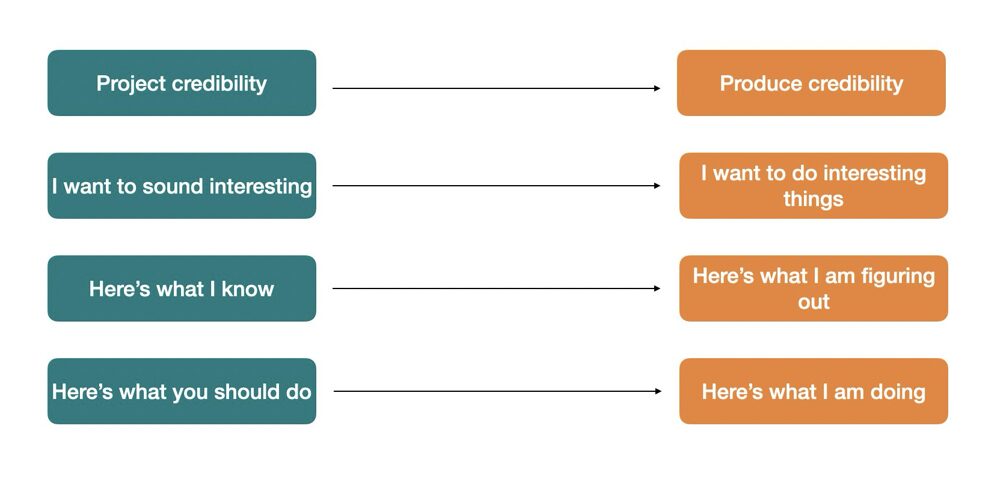
You don’t project credibility. You produce it.
You don’t try to sound interesting. You do interesting things and share what you learn.
You don’t say “Here is what I know.” You say, “Here is what I’m trying to figure out.”
You don’t say “Here is what you should do.” You say, “Here is what I’m doing.”
The keyword is doing. Present tense. The Instagram girl wasn’t looking back on a journey she’d completed. She was in the middle of it. That’s what made it real.
The way to build this evidence is to embody your idea and share it, not from the top of the mountain, but as you run the experiments.
So where does this lead?
Think of building credibility as four concentric circles.

Your own work is the innermost circle. How does your idea apply in your own life and business? What did you try this week? What failed?
Your client work is the second circle. Same questions, but in the client’s world. What specific moment in a recent client engagement brought your idea to life? (You can keep the client’s name anonymous. The specific story is what matters, not the name.)
Your field is the third circle. Who else in your domain is proving the same idea, even if they don’t know it? You didn’t do it, but you spotted it. This is the work of a curator, and it builds credibility because you’re doing the generous work of spotting patterns elsewhere and helping the audience see things differently.
Outside your field is the outermost circle. Where does the idea show up in completely different worlds? Music? Travel? Parenting? Sports? When you can pull an example from an unrelated field and make it click, you show that the idea is bigger than your niche.
One final thing: be concrete
None of this works if it stays vague.
If you’re a data consultant, show them the actual dashboard you’re building. If you design pitch decks, show a specific slide and talk about the decision behind it.
And don’t just share what worked. Share what didn’t. The experiment that flopped, the assumption that turned out to be wrong, the thing you tried that embarrassed you. When you admit what you’re bad at, what you actually got right becomes a lot more believable.
This is how we build evidence that is hard to fake.
For more stuff like this, subscribe here.